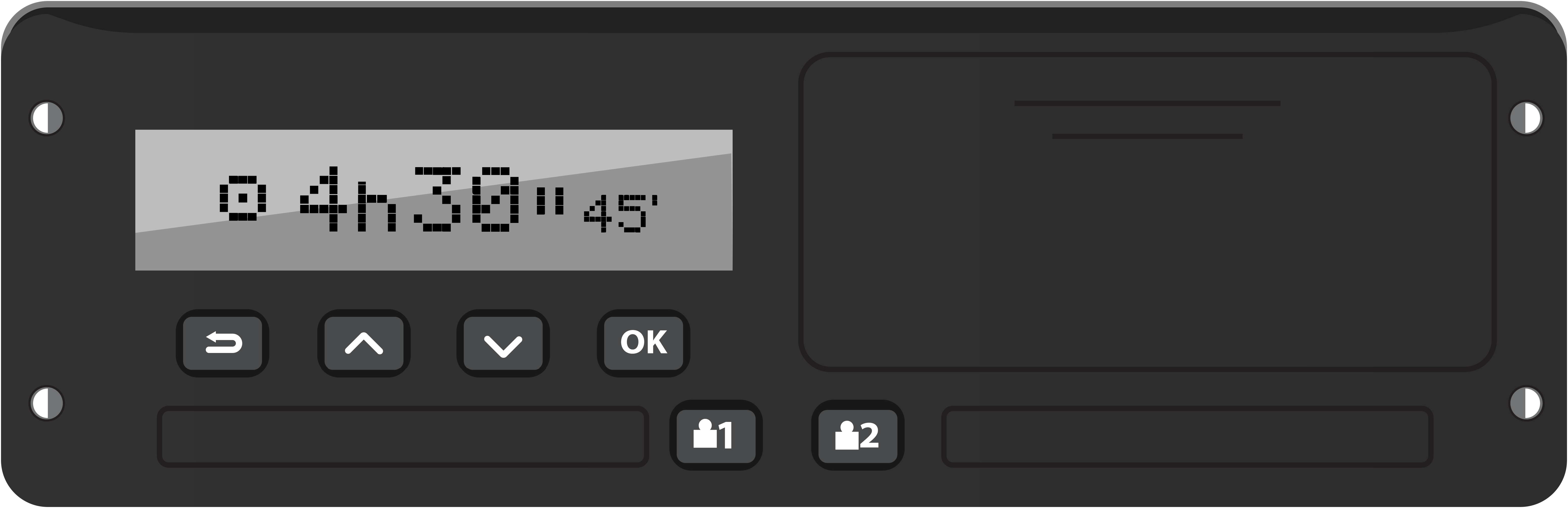
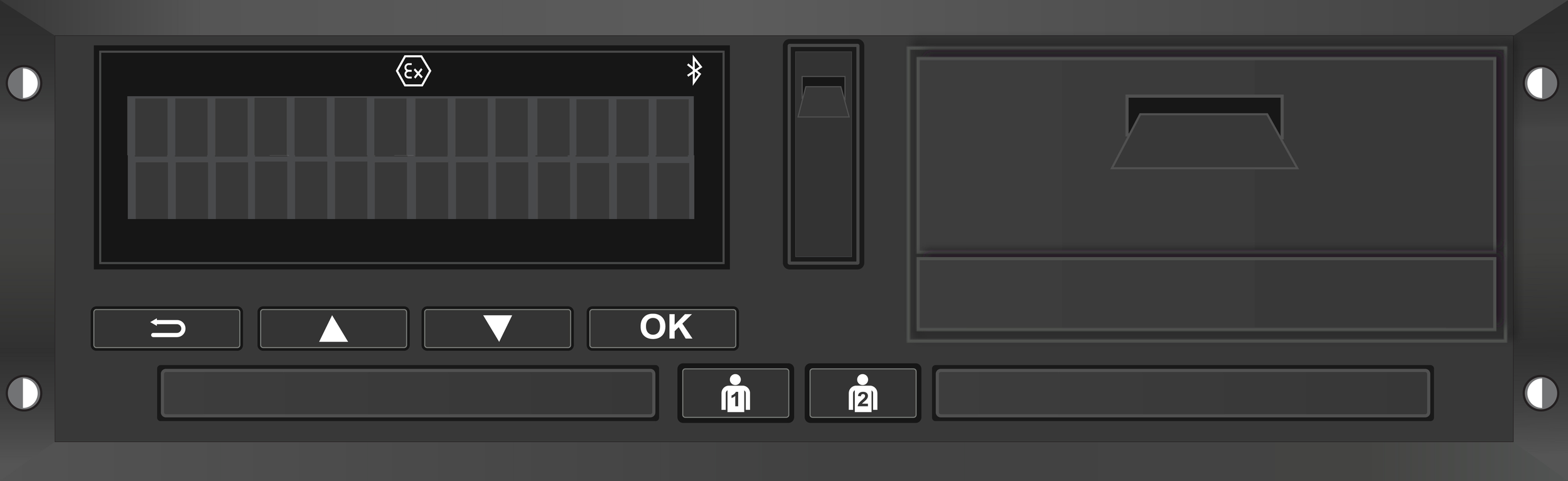
Download over Bluetooth, practise on a faithful simulation of the real device, analyse infringements and fine risk, and get personal guidance.


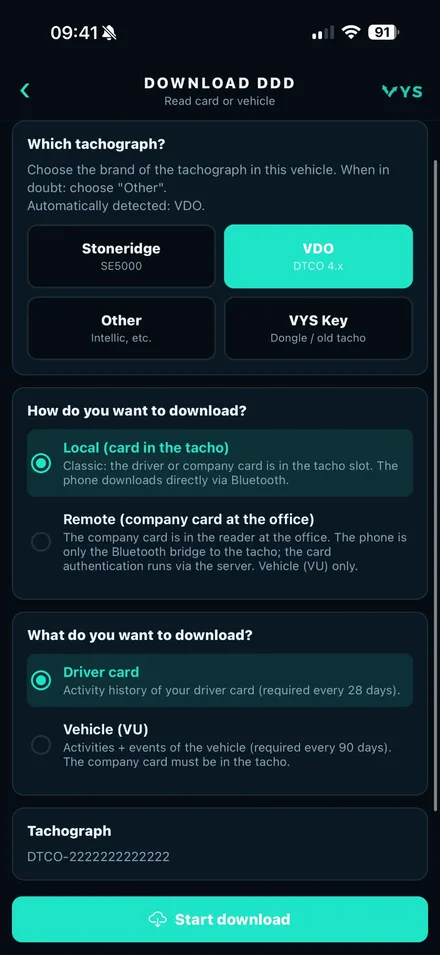
Mandatory DDD downloads straight from the tachograph to your phone. No cables. No laptop. No separate reader device.
Reading out remotely used to mean an FMS box in the cab, a fitter to install it and a running subscription per vehicle. With us it goes over Bluetooth, using the phone the driver already carries.
Driver card and vehicle unit, straight from the cab.
Every tachograph holder is required to read out the driver card and vehicle unit periodically and to keep the files in a verifiable way. VYS Tacho records every download automatically, verifies the digital signature and stores everything in a secure archive.
A DDD file (ISO 20919) is the EU-standardised format for tachograph data. VYS Tacho supports both mandatory sources.
The app connects to the tachograph over Bluetooth.
A secure session with the tachograph is set up.
The app requests the data you need (driver card or vehicle).
The data is transferred in blocks. Progress is visible.
The transfer is closed properly.
The digital signature is checked instantly. A green or amber badge shows the result.
File saved to your account. Instantly shareable by email, Drive, OneDrive or any other app.
Upload je .ddd-download en zie direct rijtijden, pauzes, dag- en weekrust, arbeid en een boete-indicatie volgens de rijtijdenwet. Inloggen via je beheerder.
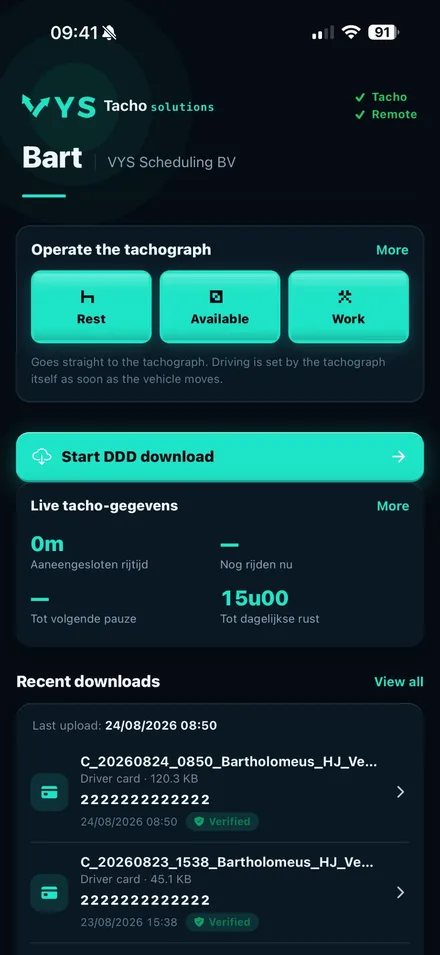
While the phone is connected over Bluetooth, all driving data is refreshed every few seconds and synchronised to the server.
Current speed straight from the tachograph
Vehicle odometer, updated per trip
Current activity of the driver and co-driver
Remaining driving time today
Remaining driving time this week
Remaining driving time over the past two weeks
The connection status is always visible in the app. There are three statuses:
Every 9 seconds the driving data is synchronised to the server. A second phone or the company portal can therefore view the same up-to-date data without a Bluetooth connection.
During a DDD download the live poll is paused temporarily so the Bluetooth connection is not disrupted. After the download the app resumes automatically.
Live data can be turned off to save battery. When off, only DDD downloads are performed and no driving data is retrieved.
The app checks at fixed intervals whether the tachograph is in range. Once the deadline has passed, the download starts without any intervention.
Faster response time for a download. Higher battery usage.
Connection only during a download attempt. Saves battery.
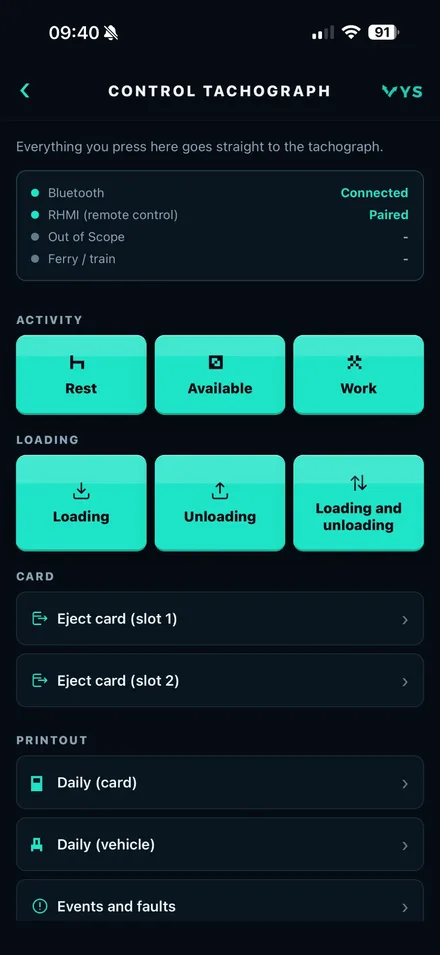
The RHMI feature (Remote Human Machine Interface) enables full operation of the tachograph from the app. Both directly over Bluetooth and remotely, using a second phone as a bridge.
This phone is connected over Bluetooth and acts as a bridge for other phones.
Another phone is the bridge. Commands are relayed through the server and executed.
No phone is connected. Remote control is not available.
After pairing and opening a session, the following commands are available:
Start pairing with a 6-digit code on the tachograph display. Once per device.
Authenticate the driver or co-driver on the tachograph from your phone.
End the active RHMI session on the tachograph.
Check whether the active session is still valid.
Set Rest, Available or Work for the driver and co-driver. Per slot separately.
Print the daily activity overview, violations, faults or a technical report.
Record loading and unloading activities directly on the tachograph.
Withdraw the driver card or co-driver card from slot 1 or slot 2.
Acknowledge outstanding warnings on the driver card or co-driver card.
After every download, VYS Tacho analyses the driving and rest times for violations and calculates the corresponding fine. Results are visible in the app right away.
Violations that are recorded but usually do not cause an immediate stop.
Higher fines, with a possible driving ban for repeated violations.
Can lead directly to a driving ban, vehicle immobilisation and high fines.
Besides the Dutch ILT rates, the app contains fine references for several European countries. For each violation, the table shows the amount, the severity and who is liable.
Set it up so you automatically receive a monthly overview by email with all new violations. For each violation: type, severity, time, driver and vehicle, with the estimated fine. Only new violations are reported.
Transport companies get access to a web portal for all drivers, tachographs, downloads and violations.
Add drivers, track download status and receive alerts when a deadline is approaching.
All paired tachographs per vehicle. Last download date and connection status visible.
Search all DDD files by driver, vehicle, date or type. Download any file again.
A complete overview of all detected violations, filtered by driver, period or severity.
See in real time which tachographs are active, the current activity per driver and available driving time.
Drivers set notifications for approaching deadlines: daily, weekly or monthly.
Tacho analysis reads the driver card, exposes every infringement and works out what it costs. The driver sees it on his own phone, in his own language, before an enforcement officer at the roadside reads the same file.
A roadside fine is the smallest part of the bill. Serious infringements are linked to the company through the European ERRU register: minor 1 point, serious 10, very serious 30 and most serious 90. The total decides how often and how strictly the company itself is inspected.
A driver score from 0 to 100 over the last 56 days, with the infringements, the ERRU points and the indicative fine below it.
Driving time, rest, breaks, card use and recording. For a manual entry he sees exactly which parts he left empty.
Fine rates per EU country based on official national sources, and whether the bill goes to the driver, the company or both.
Time when the card was not in the tachograph and the period was not entered manually. Nobody notices on the road, until someone reads the file.
For every day you can see whether there is valid card data and where the gaps are, before a missing download becomes a recording infringement.
The digital signature is verified against the European root key (ERCA). An interrupted or shortened file is reported instead of silently approved.
The driver score is not a points system of our own. One very serious infringement weighs more than ten minor ones, exactly as the authorities weigh it.
Every infringement gets its ERRU points. A day with unaccounted time counts as very serious, so 30.
The points are divided by the number of working days in the period, with a minimum of five.
Green from 90, orange from 70, red below that. A most serious infringement is always red.
The weighting comes from the authorities, the conversion to a number is VYS's. The app explains it to the driver as well.
As soon as an analysis is ready the driver gets a notification, and the app keeps asking until he confirms he has read it. In the portal the company sees per driver the score, all downloads, the coverage and whether the analysis was read and confirmed. The reminder can be switched on or off per driver, and the overview can come by email.
No rollout project, no installation in the cab and no link with the planning system.
A company account for the portal on vystacho.nl.
First name, last name and email address. That is all.
He installs Tacho analysis and logs in with that same email address.
Every analysis is in the portal, together with the driver's read confirmation.
The driver knows where he stands, and the company is no longer surprised by a file that someone else reads first.
Every DDD file is checked on receipt for its embedded signature in accordance with ISO 20919. Green confirms authenticity; amber warns of an invalid signature.
Company card authentication takes place directly between the card in the tachograph and the vehicle unit. No server is involved.
All communication between the app and the server runs over HTTPS with TLS encryption.
Session tokens are stored in the operating system's secure key vaults.
Accounts are secured with one-time codes by email. No passwords. A maximum of 5 attempts per code.
DDD files comply with the M-file format (ISO 20919). Transferable to EU enforcement authorities and accredited analysis bureaus.
All screens, notifications, the manual and fine tables are available in twenty-six languages.
Download the app on iOS or Android, or request a company account for the transport companies portal.